Table of Contents
To clean blackout curtains safely, check the sewn-in care label and the manufacturer’s instructions first. Use only the washing, dry-cleaning, dusting and drying methods they permit. Blackout curtains are not all made alike: heat, water or friction can damage some coated linings even when the face fabric looks washable.
Start by identifying the curtain model and whether blackout performance comes from a separate lining, a coating on the back or a multi-layer fabric. If the label is missing, faded or unclear, pause wet cleaning and ask the retailer or a curtain-care professional to identify a safe method.
Quick answer: the safest way to clean blackout curtains
- Follow the care code for the exact curtain, not a generic rule for all blackout fabrics.
- Remove loose dust gently only if the maker permits the tool and method.
- Machine wash or dry clean only when the product instructions explicitly allow it.
- Avoid bleach, spot solvents, ironing and steam unless the label specifically permits them.
- Stop if lining flakes, cracks, feels sticky or changes colour.

1. Check the care label and curtain construction
Find the sewn-in label, often near a side seam or the heading tape, and look for instructions supplied with the product. Check both curtain panels if you have a pair. Confirm whether the visible fabric and blackout backing are one piece or separate layers, and note any bonded, rubberised or foam-like coating. Different components can tolerate different treatments, so the label for the complete curtain is the guide to follow.
Care symbols set limits on treatment. The wash tub indicates whether domestic washing is allowed and gives a maximum temperature; bars below it indicate a gentler cycle. A crossed symbol means that treatment is prohibited. The GINETEX care-symbol guide explains the standard textile symbols, but the manufacturer’s product-specific directions still take priority.
Dunelm’s curtain-care guidance advises following the sewn-in label and recommends professional dry cleaning for coated blackout or thermal curtains covered by its guidance. That advice is not universal. For example, IKEA’s KORGMOTT product-care page lists machine washing and says not to dry clean. These product instructions differ, which is why the exact model matters.
Always follow the care instructions on the label.
Dunelm curtain-care guidance
2. Prepare the curtains before cleaning
Before taking panels down, photograph the label, the way hooks or heading tape are fitted and any existing marks or damaged areas. That record helps you put the curtains back correctly and gives a cleaner useful context if you need advice. Check whether the panels are heavy or unusually long; wet fabric becomes harder to handle and can stretch under its own weight.
- Close the curtains and inspect both sides in good light.
- Remove hooks, weights or detachable fittings only when instructions say to.
- Keep left and right panels separate if their labels or construction differ.
- Protect nearby furniture and floors while taking panels down.
- Do not pull cords, pleats or stitched heading tape apart unless directed.
Do not start with a stain remover just because a mark looks small. A product that is safe on the face fabric may affect a coating or leave a ring. Identify the stain and check permitted treatment first.
3. Remove ordinary dust without soaking the fabric
For routine dust, begin with the least aggressive method allowed by the care instructions. If the curtains can stay hanging, support the fabric so its weight does not strain the rail or heading. Use a soft brush with light strokes, or a vacuum upholstery attachment on low suction only when the maker allows vacuuming. Work in the direction of the fabric and avoid pressing a tool into the coated reverse.
Test in a discreet area before treating a larger panel. Stop if the fabric catches, pills, sheds particles, changes sheen or transfers colour to the brush or cloth. Dry dusting can remove loose surface dust; it will not remove oily marks or embedded soil. Do not keep rubbing in an attempt to make a mark disappear.
4. Treat small marks cautiously
First check whether the label permits spot treatment and whether the maker specifies a product. If it does, remove loose residue without scraping the fabric, then follow the stated method on a hidden area. Use a clean, pale cloth so you can see whether colour transfers. Blot lightly rather than scrubbing, and use only the amount of moisture and product permitted.
Do not use bleach, alcohol, household stain sprays, washing-up liquid or solvent cleaners unless the product instructions specifically approve them. Do not saturate the lining: liquid can spread beyond the mark, leave a tide line or reach layers that cannot dry evenly. If the stain remains after one permitted gentle attempt, stop and ask a specialist instead of escalating to a stronger chemical.
5. Wash only if the exact product is machine washable
A washable symbol or clear product instruction is required before machine washing. If washing is allowed, use the temperature, cycle and detergent specified by the manufacturer. Remove fittings only as directed, wash panels separately when the drum would otherwise be crowded, and avoid a long or forceful spin unless the instructions call for one. Do not assume a cold cycle makes a non-washable curtain safe.
Hand washing is not automatically gentler. A large panel can become heavy when wet, and squeezing, twisting or uneven handling may stretch seams or crease a lining. Use hand washing only when the label permits it and follow its method. If instructions are unclear, do not experiment on a full panel.
Before starting, check that the washing machine can accommodate the panel without compressing it. Keep blackout curtains separate from other laundry if the care instructions say so. Never put coated sections under tension or fold them sharply to force them into a small drum.
6. Dry and rehang according to the label
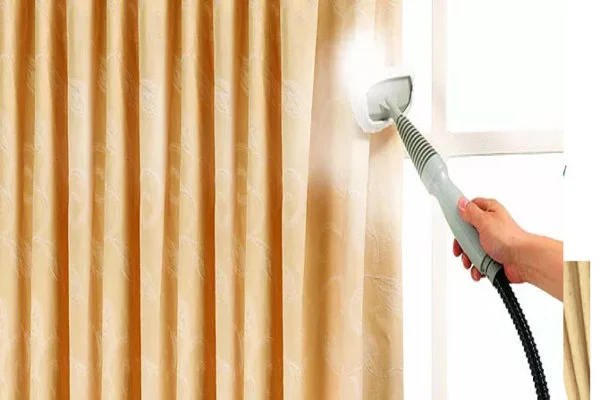
Drying is part of cleaning, not an afterthought. Follow the product’s instructions for line drying, flat drying or machine drying. Do not tumble dry, wring, iron or steam unless the care label explicitly permits that treatment. Heat can affect some linings and coatings; even a steamer held at a distance is not a safe default.
If the maker permits hanging the curtain while damp, support the full width so the wet weight is distributed. Otherwise, dry it as directed before rehanging. Allow the panel to dry completely and air the room. Do not hang damp fabric against a cold window or wall, where poor airflow can leave it musty or slow drying.
Once dry, check that the backing remains smooth and that seams, heading tape and hems have not shifted. If a panel looks different from its original condition, do not apply more heat or moisture to correct it. Ask the retailer or a curtain-care professional for next steps.
When should you choose professional curtain cleaning?
Use a specialist when the care label requires professional treatment, the panel is large or delicate, the backing is coated, or the product instructions are missing. Professional advice is also sensible for extensive staining, smoke or odour, fragile stitching, brittle backing, or curtains that may shrink or lose their shape if handled wet.
Before booking, share the label photograph, the curtain make or model if known, the type of mark and any previous cleaning attempts. Mention flaking, stickiness, cracking, discolouration or repairs before the curtains are treated. A cleaner can assess whether the fabric is suitable for cleaning and explain any limits; cleaning cannot restore a lining that has already deteriorated.
For help with curtains in the capital, see our curtain-cleaning service in London. You can also compare questions to ask in our guide to choosing a curtain-cleaning company. No treatment should begin until the care requirements and condition are understood.
Common mistakes that can damage blackout curtains
- Washing every blackout curtain because another brand’s model is washable.
- Using steam or an iron to remove creases without checking heat restrictions.
- Scrubbing a stain or soaking the backing to speed up removal.
- Applying bleach, solvent or a household cleaner without label approval.
- Ignoring an existing crack or sticky patch and continuing with wet cleaning.
- Rehanging a damp panel where air cannot circulate.
If you are unsure, pause. Confirm the product instructions or ask for professional guidance before exposing the lining to water, chemicals or heat.
Frequently asked questions
Can I machine wash blackout curtains?
Only when the label or exact product instructions say machine washing is allowed. Follow the specified temperature, cycle, detergent and drying method. Blackout curtains can have different face fabrics and linings, so one product’s instructions do not apply to every curtain.
Can I steam blackout curtains to remove creases?
Do not steam them unless the maker explicitly permits it. Heat and moisture can affect some coatings, bonded layers and linings. Check the label for ironing or steaming directions; if it gives none, ask the manufacturer before using a steamer.
Can I vacuum blackout curtains while they are hanging?
Only if the care instructions allow vacuuming and the fabric is stable. Use a soft upholstery attachment on low suction, support the panel and avoid the coated reverse. Stop if the fabric catches, changes texture or sheds material.
How do I clean a stain on blackout curtains?
Check the product’s spot-cleaning instructions first. If treatment is permitted, test it on a hidden area, blot rather than rub and avoid soaking the lining. Do not use a stain remover or solvent unless the manufacturer approves it.
What should I do if the care label is missing?
Look up the product using its retailer, model or order details and request the care instructions. Until you confirm an approved method, avoid washing, steaming and chemical spot treatments. A curtain-care professional may be able to assess the fabric and backing.
For other household cleaning tasks, use our seasonal home-cleaning checklist. When curtain-care instructions are unclear, confirm them before cleaning rather than risk damage to the lining.