Table of Contents
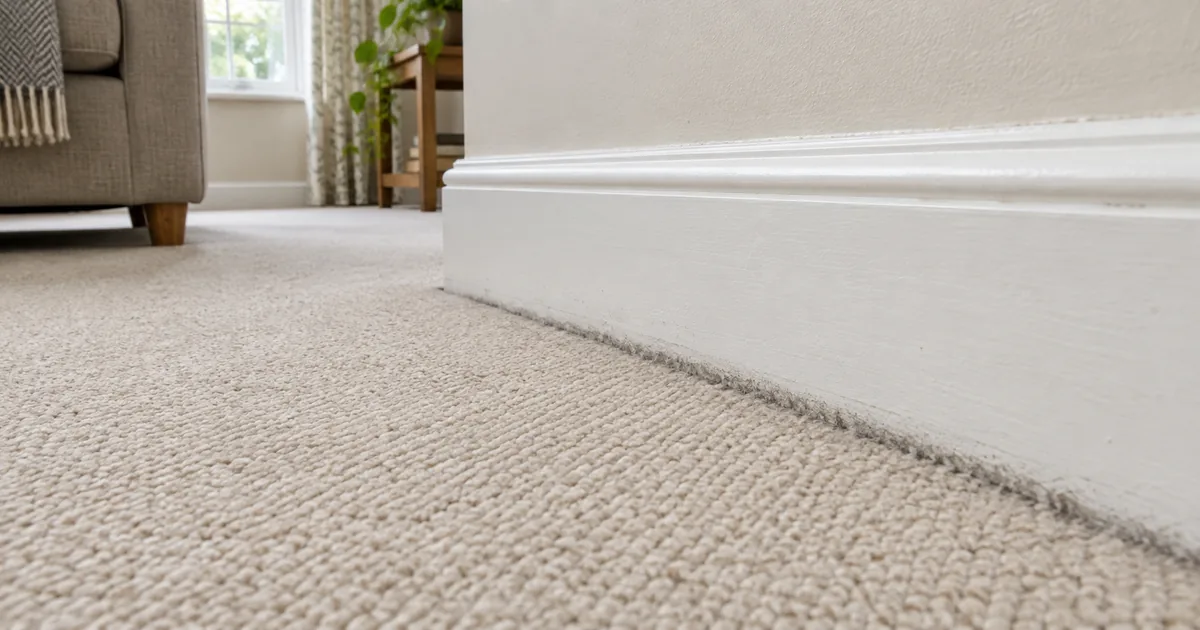
Dark lines beside carpet edges can be filtration soiling: airborne particles collect where air moves over or through carpet. Lines may appear at skirting boards, under doors or along stairs. Appearance alone cannot confirm cause, so rule out moisture, spills and other sources before treatment.
The Carpet and Rug Institute (CRI) technical bulletin describes filtration soiling as dark, greyish deposits associated with concentrated airflow. Its 2017 bulletin says this is not, by itself, a carpet defect. A dark mark can still have another cause, so check pattern and condition rather than diagnosing by colour alone.
Key takeaways
- Filtration soiling often follows airflow paths at edges, doors or stairs.
- A dark line alone cannot rule out damp, a spill or another stain.
- Check for moisture before applying a cleaning product.
- No single method guarantees complete removal of embedded deposits.
What causes dark lines along carpet edges?
Fine particles can collect where air repeatedly moves across carpet or through a small gap. CRI lists baseboards, under doors, stair edges and some floor joints as places where deposits may appear. The pattern depends on airflow, airborne material, carpet colour and time.
A line that follows a wall, doorway or stair edge is consistent with filtration soiling, but it is not proof. A spill may have a local splash shape; moisture can cause a growing mark, damp feel or musty smell. More than one issue can also be present.
How does filtration soil differ from a spill or damp?
Look at where mark appears and whether carpet feels wet, smells musty, changes over time or extends beyond an airflow path. These clues do not replace inspection. A photograph cannot show moisture beneath pile or in underlay.
If carpet feels damp, mark spreads, floor underneath is affected or a leak is possible, investigate moisture source first. See our carpet-drying advice and steps after a carpet flood.
What to check before cleaning a dark carpet edge
- Photograph both a close-up and the full room edge in natural light.
- Check whether carpet and nearby skirting feel dry; do not probe or lift fixed carpet yourself.
- Note whether line follows a doorway, wall, stair or spill location.
- Check carpet-maker care instructions before spot treatment.
- Avoid bleach, strong chemicals and overwetting; do not mix cleaning products.
Vacuuming may remove loose surface particles, but embedded or oily contamination can remain. CRI says results depend on contaminant and cleaning method; complete removal is not guaranteed. Ask a qualified cleaner to assess likely outcome before treatment.

How can you reduce further deposits?
CRI recommends reducing indoor pollutants and maintaining suitable HVAC and vacuum filtration. Include room edges in routine vacuuming, where vacuum heads may not reach. Do not seal gaps, alter doors or block vents without understanding their purpose; ask a competent building professional to investigate unusual airflow.
For marks that may be spills rather than airflow deposits, see our general stain-removal guidance. For a professional assessment, visit carpet cleaning in London or contact our team with photos.
Frequently asked questions
Are black lines around carpet edges mould?
Not necessarily. Filtration soiling can form dark lines, but appearance alone cannot rule out mould or damp. Investigate moisture, persistent musty odour or a growing patch.
Can filtration soiling be removed completely?
Cleaning may improve it, but results depend on contaminants and how deeply fibres are affected. Complete removal is not guaranteed.
Why is there a line beneath a closed door?
Air moving through or across carpet near a doorway may deposit airborne particles. CRI describes under-door lines as one possible pattern.
Does a dark carpet edge mean carpet is defective?
No. CRI says filtration soiling is not itself a carpet defect. A technician should still check for other causes.
Should I use bleach on dark carpet lines?
No. Do not use bleach or an unapproved cleaner. Confirm carpet material and likely cause, follow maker instructions, and ask for help if uncertain.
A dark edge line can have a straightforward explanation, but confirm carpet is dry and pattern fits before treatment. Share photos, location and cleaning history with our team for an assessment.